Read this poem by Mary Rita Schilke Korzan this morning and thought that I would like to share this beautiful poem with you. From Barnes and Noble, it was mentioned that Mary wrote the poem to her mother 24 years ago, thanking her for all she had done as a mother, friend, and role model. She gave the poem to her mother and, a few months later, offered it as a tribute when Mary and her husband were married.
So many wedding guests asked for a copy that Mary included one in her thank-you notes and it just spread from there until it was listed as “Author Unknown,” in A Fourth Course of Chicken Soup for the Soul, which her husband and children gave her as a Mother’s Day gift. This is a reminder to us that no deed, which is done with love and out of love, is ever too small; it surely make a different in another’s life.
——————————— When You Thought I Wasn’t Looking
When you thought I wasn’t looking
You hung my first painting on the refrigerator
And I wanted to paint another.
When you thought I wasn’t looking
You fed a stray cat
And I thought it was good to be kind to animals.
When you thought I wasn’t looking
You baked a birthday cake just for me
And I knew that little things were special things.
When you thought I wasn’t looking
You said a prayer
And I believed there was a God that I could always talk to.
When you thought I wasn’t looking
You kissed me good-night
And I felt loved.
When you thought I wasn’t looking
I saw tears come from your eyes
And I learned that sometimes things hurt—
But that it’s alright to cry.
When you thought I wasn’t looking
You smiled
And it made me want to look that pretty too.
When you thought I wasn’t looking
You cared
And I wanted to be everything I could be.
When you thought I wasn’t looking—
I looked . . .
And wanted to say thanks
For all those things you did
When you thought I wasn’t looking.
I was reading Life in the Balance by Thomas Graboys, MD, who is a nationally renowned Boston cardiologist. He not only took care of the hearts of his patients, but also their souls. In his foreword, Peter Zheutlin said,
“…what truly set Tom apart was his uncommon humanity, his intense concern for what ailed the hearts and the souls of his patients, and his unstinting generosity with his time. Despite the crushing workload he carried on his shoulders, no patient was ever rushed and no patient concern was ever belittled. A patient’s annual follow-up with Tom always ran for an hour or so, unheard of in this era of managed care. After each examination, Tom would sit, knee to knee with the patient, on a small sofa in his office and talk. He never interposed his desk. He treated you as equal.”
I respect and salute people who walked their talk! I’m quoting the above as my way of honouring a Dr. Thomas Graboys who was a great doctor, which can be so rare these days.
What also caught my attention when I was reading the book was a poem about death he found solace in. I, too, found these words comforting. Death is one heavy topic which some avoid, including myself at time, and yet it is journey everyone will take whether one chooses to or not.
I was chatting to a friend recently on Facebook and she was telling me about someone she knows in UK who is already starting to plan for his death and he was only in his twenties then. A thought immediately came to my mind then, “If we keep planning for our death, would we ever learn to truly live our life to the fullest?”
Death is a positive reminder that we would not be living forever; the time will come naturally or it may just creep up on us when we least expect. Death is just part of the whole package of living.
When the time comes for us, we will move from this end into a new beginning; “… I have only slipped away into the next room … I am I and you are you…” This poem is comforting as it described death as sort of a ‘new beginning’ that one takes on; death is not an end. I wish anyone who have lost could also find comfort in this poem.
Death is nothing at all
I have only slipped away into the next room
I am I and you are you
Whatever we were to each other
That we are still
Call me by my old familiar name
Speak to me in the easy way you always used
Put no difference into your tone
Wear no forced air of solemnity or sorrow
Laugh as we always laughed
At the little jokes we always enjoyed together
Play, smile, think of me, pray for me
Let my name be ever the household word that it always was
Let it be spoken without effort
Without the ghost of a shadow in it
Life means all that it ever meant
It is the same as it ever was
There is absolute unbroken continuity
What is death but a negligible accident?
Why should I be out of mind
Because I am out of sight?
I am waiting for you for an interval
Somewhere very near
Just around the corner
All is well.
Nothing is past; nothing is lost
One brief moment and all will be as it was before
How we shall laugh at the trouble of parting when we meet again!
Out of the night that covers me,
Black as the pit from pole to pole,
I thank whatever gods may be
For my unconquerable soul.
In the fell clutch of circumstance
I have not winced nor cried aloud.
Under the bludgeonings of chance
My head is bloody, but unbowed.
Beyond this place of wrath and tears
Looms but the Horror of the shade,
And yet the menace of the years
Finds and shall find me unafraid.
It matters not how strait the gate,
How charged with punishments the scroll, I am the master of my fate:
I am the captain of my soul.
“Invictus” is a poem written in 1875 by English poet William Ernest Henley. The word means “unconquered” in Latin.The last two lines were repeated on several occasions by Morgan Freeman in his performance as Nelson Mandela in the film “Invictus,” about Mandela’s efforts to unite his country around hosting and winning the 1995 rugby World Cup. It was said that Nelson Mandela had this poem written on a piece of paper he kept during his years in a South African prison. According to Mandela, the poem helped him cope with the pain of injustice and imprisonment.
In the movie, Mandela gives the “Invictus” poem to his national rugby team’s captain Francois Pienaar before the start of the Rugby World Cup. In reality, Mandela provided Pienaar with an extract from Theodore Roosevelt’s “The Man in the Arena” speech from 1910. An excerpt of the speech from Wikipedia as below:
It is not the critic who counts; not the man who points out how the strong man stumbles, or where the doer of deeds could have done them better. The credit belongs to the man who is actually in the arena, whose face is marred by dust and sweat and blood; who strives valiantly; who errs, who comes short again and again, because there is no effort without error and shortcoming; but who does actually strive to do the deeds; who knows great enthusiasms, the great devotions; who spends himself in a worthy cause; who at the best knows in the end the triumph of high achievement, and who at the worst, if he fails, at least fails while daring greatly, so that his place shall never be with those cold and timid souls who neither know victory nor defeat.
I hope that the poem “Invictus” can give you the strength to overcome whatever challenges that you may be facing and can inspire you like it has helped Nelson Mandela to survive 27 years in imprisonment.
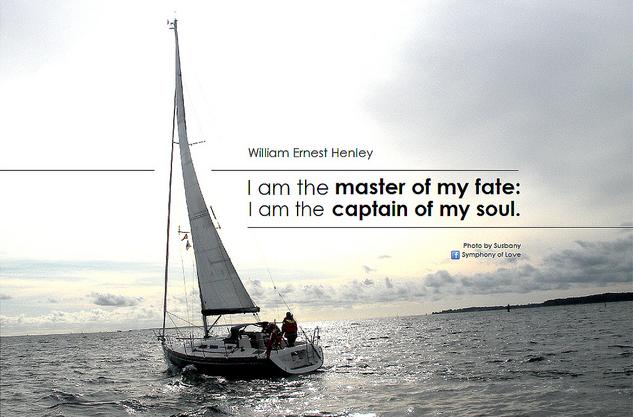
“I am the master of my fate: I am the captain of my soul.“
————————————–
Get Identity Protection. Don’t allow thieves to use your information. LifeLock helps you. Enroll Now.
This is specially dedicated to anyone who has lost a pet. I couldn’t lie to say that I understood what you had gone through since I did not own and lost any pet before. But I sincerely hope that you can find the strength to move on from the words and song. And one day, you will be reunited with your pets at the Rainbow Bridge.
The Rainbow Bridge Poem
When an animal dies that has been especially close to someone here, that pet goes to Rainbow Bridge. There are meadows and hills for all of our special friends so they can run and play together. There is plenty of food and water and sunshine, and our friends are warm and comfortable. All the animals who had been ill and old are restored to health and vigor; those who were hurt or maimed are made whole and strong again, just as we remember them in our dreams of days and times gone by.
The animals are happy and content, except for one small thing: they miss someone very special to them; who had to be left behind. They all run and play together, but the day comes when one suddenly stops and looks into the distance. The bright eyes are intent; the eager body quivers. Suddenly he begins to break away from the group, flying over the green grass, his legs carrying him faster and faster. YOU have been spotted, and when you and your special friend finally meet, you cling together in joyous reunion, never to be parted again. The happy kisses rain upon your face; your hands again caress the beloved head, and you look once more into the trusting eyes of your pet, so long gone from your life but never absent from your heart.
Do you know now that I must be going
To a place full of happy memories
In an emerald meadow by a Rainbow Bridge
You can hear heaven’s anthem on the breeze
Well, a heavenly light falls around me
In a twinkling my youth has been restored
Over green hills and valleys once again I roam free
Like the days when on eagle’s wing we soared
I’m surrounded by many companions
And together we pass our pleasant days
Every need is provided, there is nothing I lack
Save for you to whose memory my heart strays
When you’re heaven-bound
There’s a place you pass through
Called the Rainbow Bridge,
I’ll be waiting there for you
Yes, I’ll be waiting for you
With a heart that’s tried and true
Till the day I can feel , once again,
Your arms around me
Fare thee well now for I must be going
Dry your tears, no you must not cry for me
Till the day that we meet again at long journey’s end
At the Rainbow Bridge,
You know that’s where I’ll be
Join the Mailing list for Daily Love Quote in your Email now. The name and email address collected are not sold, given, or in any way disclosed to a third party. We will never give out your email address.