Invictus by William Ernest Henley
Posted on Feb 24, 2010 under Attitude, Challenges in Life, Dealing with Adversity, Determination, Inspiration, Invictus, Life, Nelson Mandela, Perseverance, Poems, Reflection, Strength, William Ernest Henley | 37 Comments
Invictus by William Ernest Henley
Out of the night that covers me,
Black as the pit from pole to pole,
I thank whatever gods may be
For my unconquerable soul.
In the fell clutch of circumstance
I have not winced nor cried aloud.
Under the bludgeonings of chance
My head is bloody, but unbowed.
Beyond this place of wrath and tears
Looms but the Horror of the shade,
And yet the menace of the years
Finds and shall find me unafraid.
It matters not how strait the gate,
How charged with punishments the scroll,
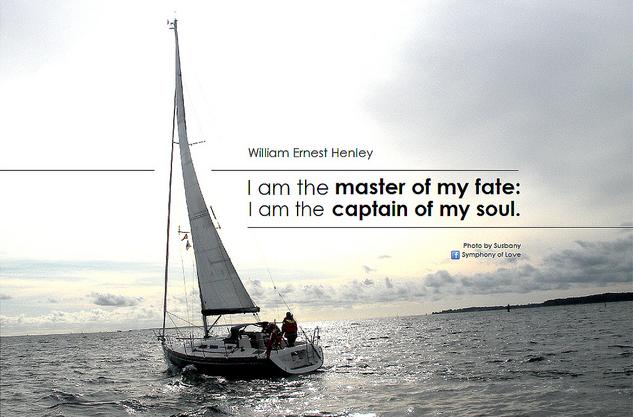
I am the master of my fate:
I am the captain of my soul.
“Invictus” is a poem written in 1875 by English poet William Ernest Henley. The word means “unconquered” in Latin.The last two lines were repeated on several occasions by Morgan Freeman in his performance as Nelson Mandela in the film “Invictus,” about Mandela’s efforts to unite his country around hosting and winning the 1995 rugby World Cup. It was said that Nelson Mandela had this poem written on a piece of paper he kept during his years in a South African prison. According to Mandela, the poem helped him cope with the pain of injustice and imprisonment.
In the movie, Mandela gives the “Invictus” poem to his national rugby team’s captain Francois Pienaar before the start of the Rugby World Cup. In reality, Mandela provided Pienaar with an extract from Theodore Roosevelt’s “The Man in the Arena” speech from 1910. An excerpt of the speech from Wikipedia as below:
It is not the critic who counts; not the man who points out how the strong man stumbles, or where the doer of deeds could have done them better. The credit belongs to the man who is actually in the arena, whose face is marred by dust and sweat and blood; who strives valiantly; who errs, who comes short again and again, because there is no effort without error and shortcoming; but who does actually strive to do the deeds; who knows great enthusiasms, the great devotions; who spends himself in a worthy cause; who at the best knows in the end the triumph of high achievement, and who at the worst, if he fails, at least fails while daring greatly, so that his place shall never be with those cold and timid souls who neither know victory nor defeat.
I hope that the poem “Invictus” can give you the strength to overcome whatever challenges that you may be facing and can inspire you like it has helped Nelson Mandela to survive 27 years in imprisonment.
“I am the master of my fate: I am the captain of my soul.“
————————————–
Get Identity Protection. Don’t allow thieves to use your information. LifeLock helps you. Enroll Now.